Off-Policy 问题
📅 发表于 2026/11/05
🔄 更新于 2026/11/05
👁️ — 次访问
📝 5362 字
⏳ 23 分钟
#TIS
#token_is
#off-policy
#训推不一致
#Routing Replay
#R2
#R3
Importance Sampling 权重分解
策略陈旧度
训推不一致
数值差异。训练和推理实现导致Policy不一致
训推2个引擎,由于计算精度、算子实现、并行方式不同等原因,
导致权重和输入相同,但token概率却不相同,产生微小且持续累积的数值偏差
Rollout:SGlang / VLLM BF16,TokenA =
Train:Megatron / FSDP FP32,TokenA =
从权重不一致来理解
自己分布下,极少出现的动作,被频繁采样送进来。在实际采样端数据相对偏少。等权训练,会让部分 token 梯度贡献偏轻或偏重,差异较大时,影响方向稳定性。 例子
| 动作 | Rollout u | Train p |
|---|---|---|
| A | 0.8 | 0.6 |
| B | 0.2 | 0.4 |
策略梯度
优势:抑制还是鼓励;动作梯度:更新方向;采样概率:决定动作在这批数据出现多少次。
单token 梯度
问题分析
100个采样样本:80个A,20个B
样本:直接平均梯度
训练:目标平均梯度
问题:
A的更新影响偏大,B的更新影响偏小。为何一定得对应当前分布,而不能是采样梯度,不能像SFT那样?
期望分布就是当前策略,而非采样策略。外部分布 作为自己训练目标。解法
下文,每个token 计算并乘以 rollout_is权重
训练梯度
1. 数值精度差异
不满足结合律:运算顺序、数值舍入不同并行策略不同:Megatron TP=2,SGlang TP=8,Allreduce存在差异。Kernal 实现方式不同:如Flash Attention V2 vs Triton attention等。精度格式不同或精度本身过低:Rollout FP8,训练 BF16:::
2. MoE Router 路由不一致
专家路由不同,选择不同专家。激活参数子空间 突变,导致优化过程不稳定。:::
3. 工程配置不对齐
采样参数不同步:temperature等未对齐假设模型预测下一个 token 的概率:
| token | 原始概率 | 累计概率 |
|---|---|---|
| A | 0.50 | 0.50 |
| B | 0.30 | 0.80 |
| C | 0.15 | 0.95 |
| D | 0.05 | 1.00 |
采样
top_p=0.8,集合S = {A, B}0.625,P(B|S)=0.3/0.8=0.3750.3;但 Rollout 实际概率 0.375训练侧
如果直接用原始概率,计算IS权重
参数明明没变,概率比却不是1,这就是采样差异。
采样候选集回放
0.375,比率为1。token 乘以权重 或 Mask
token 权重:改变采样样本对应目标分布贡献不能太大或直接mask掉。权重太大,会放大样本梯度贡献,太大了会带来波动。近似修正分布差异,会引入一定偏差。pg_loss 乘以权重: pg_losses * rollout_is_weights文章博客
Reinforce 算法为例
乘以权重后
截断IS,保持稳定
PPO 公式
原始
修正后
截断IS
| 方案 | 做法 | 作者实验中的问题或效果 |
|---|---|---|
| Vanilla-IS | 直接乘原始 rollout IS 权重 | 极大权重会放大梯度波动 |
| PPO-IS | 将 rollout 概率直接作为 PPO ratio 的分母 | 训推差异可能让样本在更新前就触发 clipping |
| TIS | 保留原 PPO ratio,额外乘上截断的 rollout 权重 | 在他们测试的较大训推差异场景中表现更稳定 |
普通截断
IcePop (蚂蚁)
仅保留 is 留在特定区间的token,如果超过,权重则为0,直接全部Mask掉。
比如 [0.5, 2.0],排除概率过于极端的样本,比如大于2 全 Mask。
GLM5 就是使用的这个。
IPO
按照概率差绝对值来Mask token,不考虑rollout_is 大小,默认为0.3
比如:
其实概率没啥变化。直接下降了0.7的概率,策略发生很大变化,却被保留了。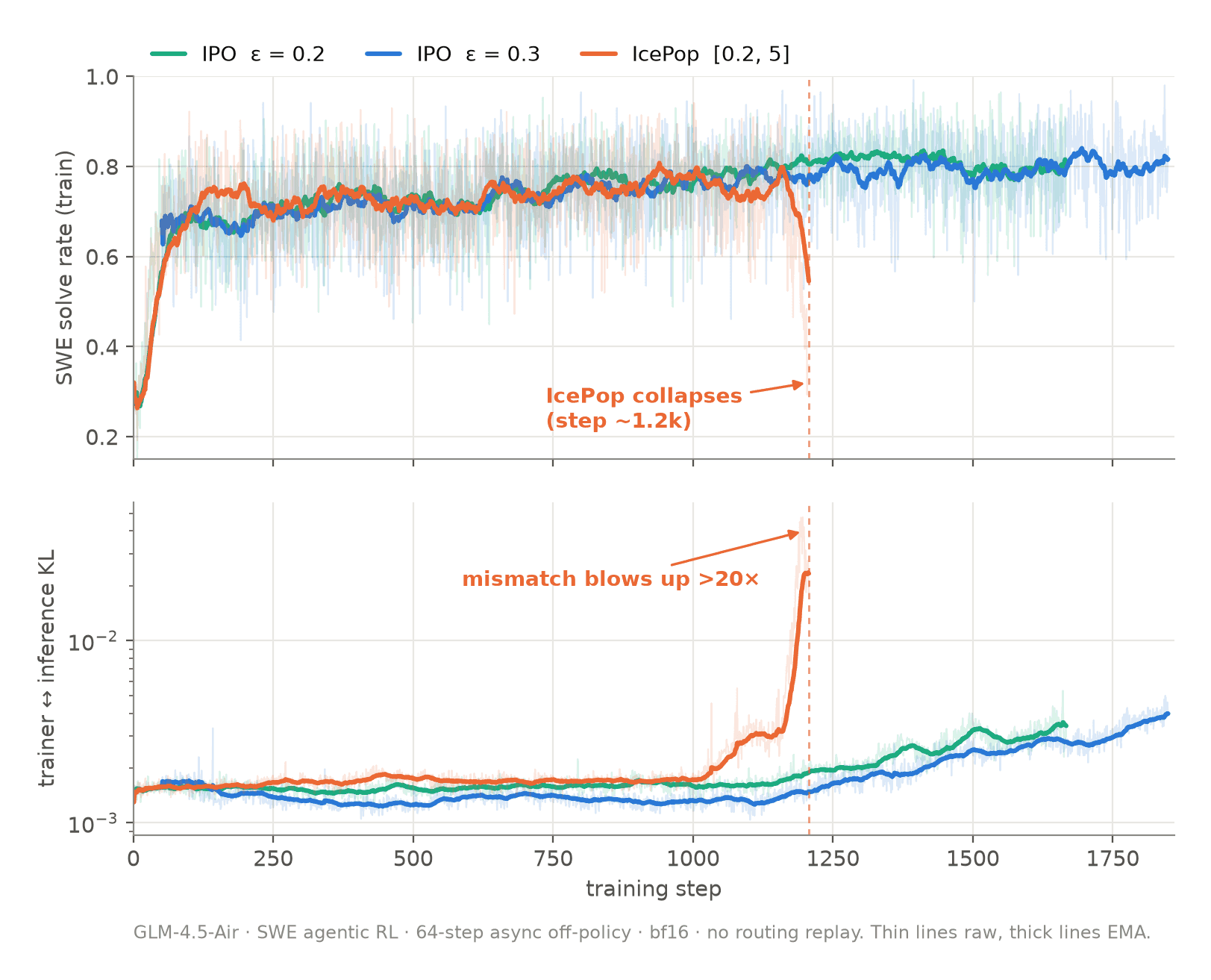
方法1:训练时强制采用采样路由路径
方法2:R2 - Vanilla Routing Replay (策略陈旧度)
训练引擎 old policy 的路由 策略陈旧度中 expert routing的影响。计算 old_log_probs → 记录 [2, 9]更新 actor → 回放 [2, 9]方法3:R3 - Rollout Routing Replay (训推不一致)
推理引擎 rollout 的路由 训推不一致和策略陈旧度中的影响。rollout → 记录 [2, 7]计算 old_log_probs → 回放 [2, 7]更新 actor → 回放 [2, 7]R3 是否一定好 (Mimo 辩证看待 R3)
使用旧路由而非自然路由,引入 biasMimo V2.6 都是使用的 R3

切换到 FP16:训练更稳定、更快收敛、性能好,FP16 10位尾数,精度比 BF16 7位尾数 高。 训推统一 FP8:统一 FP8 比 BF16训练 + FP8 rollout要好。关键层使用FP32: MiniMax-M1 把精度最敏感层 (LM head、MoE router) 用 FP32,其余保持低精度response length 动态触发 LR 衰减,把训推不一致保持在可控水平。非bypass mode下,计算优势的时候,会调用计算is,代码见 _fit_compute_advantage
def _fit_compute_advantage(self, batch) -> DataProto:
    metrics = self.metrics
    timing_raw = self.timing_raw
    reward_tensor = self.reward_tensor
    reward_extra_infos_dict = self.reward_extra_infos_dict

    with marked_timer("adv", timing_raw, color="brown"):
        # we combine with rule-based rm
        reward_extra_infos_dict: dict[str, list]
        batch.batch["token_level_scores"] = reward_tensor

        if reward_extra_infos_dict:
            batch.non_tensor_batch.update({k: np.array(v) for k, v in reward_extra_infos_dict.items()})

        # compute rewards. apply_kl_penalty if available
        if self.config.algorithm.use_kl_in_reward:
            batch, kl_metrics = apply_kl_penalty(
                batch, kl_ctrl=self.kl_ctrl_in_reward, kl_penalty=self.config.algorithm.kl_penalty
            )
            metrics.update(kl_metrics)
        else:
            batch.batch["token_level_rewards"] = batch.batch["token_level_scores"]

        # Compute rollout correction: IS weights, rejection sampling, and metrics
        # Only runs in decoupled mode (computes once per batch using stable π_old)
        # In bypass mode, this is skipped - actor computes metrics from evolving π_θ vs π_rollout
        rollout_corr_config = self.config.algorithm.get("rollout_correction", None)
        bypass_recomputing_logprobs = rollout_corr_config and rollout_corr_config.get("bypass_mode", False)
        if (
            rollout_corr_config is not None
            and "rollout_log_probs" in batch.batch
            and not bypass_recomputing_logprobs  # Only in decoupled mode
        ):
            from verl.trainer.ppo.rollout_corr_helper import compute_rollout_correction_and_add_to_batch

            # Compute IS weights, apply rejection sampling, compute metrics
            batch, is_metrics = compute_rollout_correction_and_add_to_batch(batch, rollout_corr_config)
            # IS and off-policy metrics already have rollout_corr/ prefix
            metrics.update(is_metrics)

        # compute advantages, executed on the driver process
        norm_adv_by_std_in_grpo = self.config.algorithm.get(
            "norm_adv_by_std_in_grpo", True
        )  # GRPO adv normalization factor

        batch = compute_advantage(
            batch,
            adv_estimator=self.config.algorithm.adv_estimator,
            gamma=self.config.algorithm.gamma,
            lam=self.config.algorithm.lam,
            num_repeat=self.config.actor_rollout_ref.rollout.n,
            norm_adv_by_std_in_grpo=norm_adv_by_std_in_grpo,
            config=self.config.algorithm,
        )
return batchlog_ratiorollout_is_weightsmodified_response_maskoffpolicy_metrics (KL, PPL, χ²)def compute_rollout_correction_and_rejection_mask(
old_log_prob: torch.Tensor,
rollout_log_prob: torch.Tensor,
response_mask: torch.Tensor,
rollout_is: Optional[str] = None,
rollout_is_threshold: Optional[str | float] = 2.0,
rollout_is_batch_normalize: bool = False,
rollout_rs: Optional[str] = None,
rollout_rs_threshold: Optional[str | float] = None,
) -> tuple[Optional[DataProto], torch.Tensor, dict[str, float]]:
"""Unified interface for computing IS weights and rejection masks.
This function combines IS weight calculation (truncated) and rejection sampling (masked)
into a single pipeline.
Key design:
- Separation of IS weights (for variance reduction) and rejection masks (for sample filtering)
- Comprehensive metrics tracking for mismatch diagnosis
Args:
old_log_prob: Log probabilities from the training policy (e.g., FSDP FP32),
shape (batch_size, seq_length).
rollout_log_prob: Log probabilities from the rollout policy (e.g., vLLM BF16),
shape (batch_size, seq_length).
response_mask: Binary mask for valid tokens (1=valid, 0=padding),
shape (batch_size, seq_length).
rollout_is: IS weight aggregation level (see compute_rollout_correction_weights for options).
Set to None to disable IS weight computation.
rollout_is_threshold: Threshold specification for IS weights.
Single float implies TIS; "lower_upper" implies IcePop.
rollout_rs: Rejection sampling aggregation modes as a comma separated string
(see compute_rollout_rejection_mask for the full list). Set to None to disable
rejection sampling.
rollout_rs_threshold: Threshold specification string (see compute_rollout_rejection_mask for details).
Provide one threshold per option (comma separated). For K1-style options, specify
``lower_upper`` to denote the lower/upper ratio bounds.
rollout_is_batch_normalize: Whether to normalize IS weights to have mean=1.0 per batch.
Default: False.
Returns:
Tuple containing:
rollout_is_weights_proto: DataProto with IS weights (None if rollout_is is None),
key "rollout_is_weights", shape (batch_size, seq_length).
modified_response_mask: Response mask with rejection sampling applied,
shape (batch_size, seq_length).
metrics: Dictionary of all metrics (prefixed with "rollout_corr/"), including:
- IS weight statistics
- Rejection sampling rates
- Policy mismatch metrics (KL, PPL, etc.)
"""
# Validate input masks
if not response_mask.any():
raise ValueError("response_mask must contain at least one valid token (1).")
if old_log_prob.shape != rollout_log_prob.shape:
raise ValueError(
f"old_log_prob shape {old_log_prob.shape} does not match rollout_log_prob shape {rollout_log_prob.shape}."
)
if old_log_prob.shape != response_mask.shape:
raise ValueError(
f"log_prob shape {old_log_prob.shape} does not match response_mask shape {response_mask.shape}."
)
# Step 1: Compute log ratio (log(π_train / π_rollout))
log_ratio: torch.Tensor = old_log_prob - rollout_log_prob
metrics: dict[str, float] = {}
# Step 2: Compute IS weights (if enabled)
rollout_is_weights: Optional[torch.Tensor] = None
if rollout_is is not None and rollout_is_threshold is not None:
rollout_is_weights, is_metrics = compute_rollout_correction_weights(
log_ratio=log_ratio,
response_mask=response_mask,
rollout_is=rollout_is,
rollout_is_threshold=rollout_is_threshold,
rollout_is_batch_normalize=rollout_is_batch_normalize,
)
metrics.update(is_metrics)
# Step 3: Compute rejection mask (if enabled)
modified_response_mask: torch.Tensor = response_mask.clone()
if rollout_rs is not None:
if rollout_rs_threshold is None:
raise ValueError(
"rollout_rs_threshold must be explicitly provided when rollout_rs is enabled. "
"Set rollout_rs_threshold to the desired threshold value."
)
modified_response_mask, rs_metrics = compute_rollout_rejection_mask(
log_ratio=log_ratio,
response_mask=response_mask,
rollout_rs=rollout_rs,
rollout_rs_threshold=rollout_rs_threshold,
)
metrics.update(rs_metrics)
# Step 4: Compute off-policy metrics (KL, PPL, χ², etc.)
offpolicy_metrics: dict[str, float] = compute_offpolicy_metrics(
old_log_prob=old_log_prob,
rollout_log_prob=rollout_log_prob,
response_mask=response_mask,
)
metrics.update(offpolicy_metrics)
# Step 6: Add "rollout_corr/" prefix to all metrics for logging consistency
metrics_scalar: dict[str, float] = {}
for key, value in metrics.items():
if isinstance(value, torch.Tensor):
metrics_scalar[f"rollout_corr/{key}"] = value.item()
else:
metrics_scalar[f"rollout_corr/{key}"] = value
# Step 7: Wrap IS weights in DataProto for consistency with API
rollout_is_weights_proto: Optional[DataProto] = None
if rollout_is_weights is not None:
rollout_is_weights_proto = DataProto.from_dict(tensors={"rollout_is_weights": rollout_is_weights})
return rollout_is_weights_proto, modified_response_mask, metrics_scalartoken-level
sequence-level
masked_sum(log_ratio, response_mask, axis=-1).unsqueeze(-1) shape=[bs, 1],记得 clip 一下。torch.exp(log_ratio_sum).expand_as(log_ratio)TIS 方式
IS 指标
| 指标 | 当前实现 |
|---|---|
rollout_is_mean | (\frac1N\sum_t w_t) |
rollout_is_std | 处理后权重的总体标准差 |
rollout_is_ratio_fraction_high | 原始比值超过上界的比例 |
rollout_is_ratio_fraction_low | 原始比值低于下界的比例 |
rollout_is_oob_ratio | IcePop 原始比值落在区间外的比例 |
def compute_rollout_correction_weights(
    log_ratio: torch.Tensor,
    response_mask: torch.Tensor,
    rollout_is: str = "token",
    rollout_is_threshold: str | float = 2.0,
    rollout_is_batch_normalize: bool = False,
) -> tuple[torch.Tensor, dict[str, float]]:
    """Compute importance sampling weights to correct for off-policy distribution shifts.

    This function calculates IS weights (π_train / π_rollout) using log ratios for numerical stability.
    It supports multiple aggregation levels and truncates extreme weights to prevent training instability.

    Key design:
    - Log-space computations to avoid overflow
    - Truncation of extreme weights (TIS: Truncated Importance Sampling)
    - Optional batch normalization (normalize to mean=1.0)
    - Metrics tracking for weight distribution analysis

    Args:
        log_ratio: Log ratio of training policy probability to rollout policy probability,
            shape (batch_size, seq_length).
        response_mask: Binary mask for valid tokens (1=valid, 0=padding),
            shape (batch_size, seq_length).
        rollout_is: IS weight aggregation level, must be one of:
            - "token": Per-token weights (biased, low variance)
            - "sequence": Per-sequence weight (product of tokens; unbiased, high variance)
        rollout_is_threshold: Threshold specification for IS weights.
            - Single float or float-like string: TIS, clamp weights to the upper bound
            - "lower_upper" string: IcePop, zero weights outside [lower, upper]
        rollout_is_batch_normalize: Whether to normalize IS weights to have mean=1.0 per batch,
            default False.

    Returns:
        Tuple containing:
            rollout_is_weights: Truncated IS weights (masked to zero for padding tokens),
                shape (batch_size, seq_length). If batch_normalize=True, normalized to mean=1.0.
            metrics: Dictionary of IS weight metrics (all scalars), including:
                - rollout_is_mean/max/min: Statistic of weights (before batch normalization)
                - rollout_is_eff_sample_size: Effective sample size (ESS)
                - rollout_is_seq_*: Sequence-level weight statistics
                - rollout_is_batch_norm_factor: Normalization factor (only if batch_normalize=True)
    """
    # Validate input parameters
    valid_is_levels = {"token", "sequence"}
    if rollout_is not in valid_is_levels:
        raise ValueError(f"Invalid rollout_is: {rollout_is}. Must be one of {valid_is_levels}.")
    rollout_is_threshold_upper, rollout_is_threshold_lower = _parse_rollout_is_threshold(rollout_is_threshold)
    use_icepop = rollout_is_threshold_lower is not None

    # Compute IS weights from log ratio (handles different aggregation levels)
    if rollout_is == "token":
        # Per-token IS weight: exp(log(π_train/π_rollout)) with safety clamp
        log_ratio_for_metrics: torch.Tensor = log_ratio
        log_ratio_safe: torch.Tensor = torch.clamp(log_ratio, min=-SAFETY_BOUND, max=SAFETY_BOUND)
        raw_rollout_is_weights: torch.Tensor = torch.exp(log_ratio_safe)

    elif rollout_is == "sequence":
        # Sequence-level IS weight: product of token ratios (exp(sum(log ratios)))
        log_ratio_sum: torch.Tensor = verl_F.masked_sum(log_ratio, response_mask, axis=-1).unsqueeze(
            -1
        )  # Shape: (batch_size, 1)
        log_ratio_for_metrics = log_ratio_sum

        log_ratio_sum_safe: torch.Tensor = torch.clamp(log_ratio_sum, min=-SAFETY_BOUND, max=SAFETY_BOUND)
        raw_rollout_is_weights = torch.exp(log_ratio_sum_safe).expand_as(log_ratio)  # Broadcast to sequence length #

    else:
        raise ValueError(f"Unsupported rollout_is: {rollout_is}")

    # Zero out weights for padding tokens using response mask
    raw_rollout_is_weights = raw_rollout_is_weights * response_mask

    # Apply TIS for a single upper bound and IcePop for a lower_upper string.
    if not use_icepop:
        rollout_is_weights = raw_rollout_is_weights.clamp(max=rollout_is_threshold_upper)
    else:
        assert rollout_is_threshold_lower is not None
        token_kept_mask = (raw_rollout_is_weights >= rollout_is_threshold_lower) & (
            raw_rollout_is_weights <= rollout_is_threshold_upper
        )
        rollout_is_weights = torch.where(
            token_kept_mask, raw_rollout_is_weights, torch.zeros_like(raw_rollout_is_weights)
        )

    # Compute IS weight metrics.
    metrics: dict[str, float] = compute_is_metrics(
        rollout_is_weights=rollout_is_weights,
        raw_rollout_is_weights=raw_rollout_is_weights,
        log_ratio_for_metrics=log_ratio_for_metrics,
        response_mask=response_mask,
        rollout_is=rollout_is,
        rollout_is_threshold=rollout_is_threshold_upper,
        rollout_is_threshold_lower=rollout_is_threshold_lower,
    )
    if use_icepop:
        assert rollout_is_threshold_lower is not None
        oob_mask = (raw_rollout_is_weights < rollout_is_threshold_lower) | (
            raw_rollout_is_weights > rollout_is_threshold_upper
        )
        metrics["rollout_is_oob_ratio"] = verl_F.masked_mean(oob_mask.float(), response_mask).item()

    # Detach weights to prevent gradient flow (mathematically required by IS theory)
    # IS weights change the measure, not the objective. See §3.2.2 in docs/algo/rollout_corr_math.md
    rollout_is_weights = rollout_is_weights.detach()

    # Apply batch normalization if requested
    if rollout_is_batch_normalize:
        # Compute mean based on aggregation level
        mask_float = response_mask.to(dtype=rollout_is_weights.dtype)
        if rollout_is == "token":
            # Token-level: normalize over all token weights
            if torch.distributed.is_available() and torch.distributed.is_initialized():
                weights_mean = verl_F.distributed_masked_mean(rollout_is_weights, mask_float)
            else:
                weights_mean = verl_F.masked_mean(rollout_is_weights, response_mask)
        elif rollout_is == "sequence":
            # Sequence-level: normalize over sequence weights (one weight per sequence)
            # For each sequence, compute mean over valid tokens (they all have the same weight)
            # then average across sequences
            seq_weights = verl_F.masked_mean(rollout_is_weights, response_mask, axis=-1)  # (batch_size,)
            seq_mask = (response_mask.sum(dim=-1) > 0).to(dtype=rollout_is_weights.dtype)
            if torch.distributed.is_available() and torch.distributed.is_initialized():
                weights_mean = verl_F.distributed_masked_mean(seq_weights, seq_mask)
            else:
                weights_mean = (seq_weights * seq_mask).sum() / seq_mask.sum().clamp_min(1e-8)
        else:
            raise ValueError(f"Unsupported rollout_is: {rollout_is}")

        # Normalize to mean=1.0 (avoid division by zero)
        if weights_mean > 1e-8:
            rollout_is_weights = rollout_is_weights / weights_mean
            metrics["rollout_is_batch_norm_factor"] = weights_mean.item()
        else:
            metrics["rollout_is_batch_norm_factor"] = 1.0

return rollout_is_weights, metrics核心
训推概率差异,把超出阈值的位置,从训练mask中给除掉。区别
token IS 调整各 token 的权重sequence RS 根据整条序列的差异决定是否保留def compute_rollout_rejection_mask(
log_ratio: torch.Tensor,
response_mask: torch.Tensor,
rollout_rs: str = "token_k1",
rollout_rs_threshold: Optional[str | float] = None,
) -> tuple[torch.Tensor, dict[str, float]]:
"""Compute hard trust region mask using divergence estimators.
This function enforces a hard trust region constraint by masking tokens/sequences
where the estimated divergence (between training and rollout policies) exceeds
a threshold. Unlike PPO's soft clipping, this provides a hard boundary.
Multiple rejection criteria can be supplied via a comma separated `rollout_rs` string.
All requested options must pass for a token/sequence to remain valid.
Supported KL divergence-based modes (ideal = 0.0 unless noted):
- "token_k{1,2,3}": Token-level divergences.
- "seq_sum_k{1,2,3}": Sum of token divergences per sequence.
- "seq_mean_k{1,2,3}": Mean of token divergences per sequence.
- "seq_max_k{2,3}": Maximum token divergence per sequence.
Args:
log_ratio: Log ratio of training policy probability to rollout policy probability,
shape (batch_size, seq_length).
response_mask: Binary mask for valid tokens (1=valid, 0=padding),
shape (batch_size, seq_length).
rollout_rs: Comma separated rejection sampling options (e.g. "token_k1,seq_sum_k3").
rollout_rs_threshold: Threshold specification string (required). Provide one entry per
rollout_rs option separated by commas. Each entry must be a positive number.
For K1-style options (``*k1``), specify ``lower_upper`` (e.g. ``"0.1_1.2"``)
to denote lower/upper ratio bounds; other options accept a single upper bound.
Returns:
Tuple containing:
modified_response_mask: Response mask with trust region violations masked (0=rejected),
shape (batch_size, seq_length).
metrics: Dictionary of trust region metrics (all scalars).
"""
if rollout_rs is None or not isinstance(rollout_rs, str):
raise ValueError("rollout_rs must be a non-empty string (comma separated for multiple options).")
if rollout_rs_threshold is None:
raise ValueError("rollout_rs_threshold must be provided for rejection sampling.")
if log_ratio.shape[0] == 0:
return response_mask, {}
# rollout_rs supports chained criteria via comma separation (e.g. "token_k1,seq_mean_k3").
# Every listed option must pass; combined_mask aggregates them via logical AND.
option_modes = [opt.strip() for opt in rollout_rs.split(",") if opt.strip()]
if not option_modes:
raise ValueError("rollout_rs must contain at least one valid option.")
normalized_options: list[str] = []
seen: set[str] = set()
for opt in option_modes:
if opt not in SUPPORTED_ROLLOUT_RS_OPTIONS:
raise ValueError(
f"Invalid rollout_rs option: {opt}. Must be one of {sorted(SUPPORTED_ROLLOUT_RS_OPTIONS)}."
)
if opt not in seen:
normalized_options.append(opt)
seen.add(opt)
threshold_specs = _parse_rollout_rs_thresholds(normalized_options, rollout_rs_threshold)
log_ratio_safe: torch.Tensor = torch.clamp(log_ratio, min=-SAFETY_BOUND, max=SAFETY_BOUND)
token_k1: torch.Tensor = -log_ratio_safe
token_k2: torch.Tensor = 0.5 * log_ratio_safe**2
token_k3: torch.Tensor = torch.exp(log_ratio_safe) - 1.0 - log_ratio_safe
response_mask_bool: torch.Tensor = response_mask.bool()
seq_valid_mask: torch.Tensor = response_mask.sum(dim=-1) > 0
# combined_mask accumulates per-option passes; any failure flips tokens to 0.
combined_mask: torch.Tensor = torch.ones_like(response_mask, dtype=log_ratio.dtype)
metrics: dict[str, float] = {}
def _sequence_sum(values: torch.Tensor) -> torch.Tensor:
return verl_F.masked_sum(values, response_mask, axis=-1)
def _sequence_mean(values: torch.Tensor) -> torch.Tensor:
return verl_F.masked_mean(values, response_mask, axis=-1)
def _sequence_max(values: torch.Tensor) -> torch.Tensor:
mask_bool = response_mask.bool()
neg_inf = torch.tensor(float("-inf"), device=values.device, dtype=values.dtype)
masked_values = values.masked_fill(~mask_bool, neg_inf)
max_values = masked_values.max(dim=-1).values
return torch.where(max_values == neg_inf, torch.zeros_like(max_values), max_values)
for option_name in normalized_options:
thresholds_info = threshold_specs[option_name]
is_k1_option = option_name.endswith("k1")
upper_value = thresholds_info["upper"]
lower_value = thresholds_info["lower"]
apply_lower_threshold = is_k1_option
lower_log: Optional[float] = None
upper_log: Optional[float] = None
if is_k1_option:
if lower_value is None or upper_value is None:
raise ValueError(
f"rollout_rs_threshold for option '{option_name}' must specify both lower and upper bounds."
)
lower_log = math.log(lower_value)
upper_log = math.log(upper_value)
else:
if upper_value is None:
raise ValueError(f"rollout_rs_threshold for option '{option_name}' must specify an upper bound.")
level = "sequence" if option_name not in TOKEN_LEVEL_ROLLOUT_RS_OPTIONS else "token"
per_token_stat: torch.Tensor
per_sequence_stat: Optional[torch.Tensor] = None
token_keep_bool: torch.Tensor
if option_name == "token_k1":
if lower_log is None:
raise ValueError("Threshold specification for token_k1 must include lower and upper bounds.")
per_token_stat = token_k1
token_keep_bool = (per_token_stat >= lower_log) & (per_token_stat <= upper_log)
elif option_name == "token_k2":
per_token_stat = token_k2
token_keep_bool = per_token_stat <= upper_value
elif option_name == "token_k3":
per_token_stat = token_k3
token_keep_bool = per_token_stat <= upper_value
elif option_name.startswith("seq_sum"):
if option_name.endswith("k1"):
if lower_log is None:
raise ValueError(
f"Threshold specification for option '{option_name}' must include lower and upper bounds."
)
seq_stat = _sequence_sum(token_k1)
seq_keep_bool_direct = (seq_stat >= lower_log) & (seq_stat <= upper_log)
elif option_name.endswith("k2"):
seq_stat = _sequence_sum(token_k2)
seq_keep_bool_direct = seq_stat <= upper_value
elif option_name.endswith("k3"):
seq_stat = _sequence_sum(token_k3)
seq_keep_bool_direct = seq_stat <= upper_value
else:
raise ValueError(f"Unsupported rollout_rs option: {option_name}.")
per_sequence_stat = seq_stat
token_keep_bool = seq_keep_bool_direct.unsqueeze(-1).expand_as(response_mask_bool)
per_token_stat = seq_stat.unsqueeze(-1).expand_as(response_mask)
elif option_name.startswith("seq_mean"):
if option_name.endswith("k1"):
if lower_log is None:
raise ValueError(
f"Threshold specification for option '{option_name}' must include lower and upper bounds."
)
seq_stat = _sequence_mean(token_k1)
seq_keep_bool_direct = (seq_stat >= lower_log) & (seq_stat <= upper_log)
elif option_name.endswith("k2"):
seq_stat = _sequence_mean(token_k2)
seq_keep_bool_direct = seq_stat <= upper_value
elif option_name.endswith("k3"):
seq_stat = _sequence_mean(token_k3)
seq_keep_bool_direct = seq_stat <= upper_value
else:
raise ValueError(f"Unsupported rollout_rs option: {option_name}.")
per_sequence_stat = seq_stat
token_keep_bool = seq_keep_bool_direct.unsqueeze(-1).expand_as(response_mask_bool)
per_token_stat = seq_stat.unsqueeze(-1).expand_as(response_mask)
elif option_name.startswith("seq_max"):
if option_name.endswith("k2"):
seq_stat = _sequence_max(token_k2)
seq_keep_bool_direct = seq_stat <= upper_value
elif option_name.endswith("k3"):
seq_stat = _sequence_max(token_k3)
seq_keep_bool_direct = seq_stat <= upper_value
else:
raise ValueError(f"Unsupported rollout_rs option: {option_name}.")
per_sequence_stat = seq_stat
token_keep_bool = seq_keep_bool_direct.unsqueeze(-1).expand_as(response_mask_bool)
per_token_stat = seq_stat.unsqueeze(-1).expand_as(response_mask)
else:
raise ValueError(f"Unsupported rollout_rs option: {option_name}.")
metrics_upper_threshold = upper_log if is_k1_option else upper_value
metrics_lower_threshold = lower_log if (is_k1_option and lower_log is not None) else 0.0
token_keep_mask = token_keep_bool.to(dtype=log_ratio.dtype)
combined_mask = combined_mask * token_keep_mask
seq_keep_bool_tensor = (~((~token_keep_bool) & response_mask_bool)).all(dim=-1)
option_metrics = compute_rs_metrics(
option_name=option_name,
rs_statistic=per_token_stat,
response_mask=response_mask,
seq_valid_mask=seq_valid_mask,
level=level,
per_sequence_values=per_sequence_stat,
rollout_rs_threshold=metrics_upper_threshold,
rollout_rs_threshold_lower=metrics_lower_threshold,
apply_lower_threshold=apply_lower_threshold,
)
metrics.update(option_metrics)
token_masked_fraction = verl_F.masked_mean(1 - token_keep_mask, response_mask).item()
seq_valid_float = seq_valid_mask.float()
if seq_valid_float.sum() > 0:
seq_keep_float = seq_keep_bool_tensor.to(dtype=log_ratio.dtype)
seq_masked_fraction = (((1.0 - seq_keep_float) * seq_valid_float).sum() / seq_valid_float.sum()).item()
else:
seq_masked_fraction = 0.0
metrics[f"rollout_rs_{option_name}_masked_fraction"] = token_masked_fraction
metrics[f"rollout_rs_{option_name}_seq_masked_fraction"] = seq_masked_fraction
final_mask = combined_mask
metrics["rollout_rs_masked_fraction"] = verl_F.masked_mean(1 - final_mask, response_mask).item()
final_keep_bool = (final_mask > 0.5) & response_mask_bool
seq_has_masked: torch.Tensor = (~final_keep_bool & response_mask_bool).any(dim=-1)
metrics["rollout_rs_seq_masked_fraction"] = seq_has_masked.float().mean().item()
modified_response_mask: torch.Tensor = (response_mask * final_mask).to(dtype=response_mask.dtype)
return modified_response_mask, metricsKL 和 K3L
PPL 和 log PPL
χ² 与 IS 方差
def compute_offpolicy_metrics(
    old_log_prob: torch.Tensor,
    rollout_log_prob: Optional[torch.Tensor],
    response_mask: torch.Tensor,
) -> dict[str, Any]:
    """Compute off-policy diagnostic metrics (helper function).

    This helper function operates on raw tensors and is used internally by:
    - compute_rollout_correction_and_rejection_mask() in this module (automatically included)
    - Tests (test_rollout_corr.py, test_rollout_corr_integration.py)

    These metrics help diagnose the off-policy gap between rollout and training policies,
    which can arise from:
    - Policy mismatch (e.g., vLLM BF16 vs FSDP FP32)
    - Model staleness (training on trajectories from older checkpoints)
    - General distribution shifts

    Key metrics:
    - kl: Direct KL divergence estimator KL(π_rollout || π_training)
    - k3_kl: K3 KL estimator for stability (more stable for small KL)
    - training_ppl: Perplexity of training policy
    - rollout_ppl: Perplexity of rollout policy
    - log_ppl_diff: Difference in log perplexities
    - ppl_ratio: Ratio of training PPL to rollout PPL
    - chi2_token: Token-level χ² divergence E[ρ²] - 1
    - chi2_seq: Sequence-level χ² divergence E[(∏ρ_t)²] - 1

    Args:
        old_log_prob: Log probabilities from training policy, shape (batch_size, seq_length)
        rollout_log_prob: Log probabilities from rollout policy, shape (batch_size, seq_length)
        response_mask: Mask for valid tokens, shape (batch_size, seq_length)

    Returns:
        Dictionary of off-policy metrics (without prefix)
    """
    # Validate that we have at least one valid token
    assert response_mask.any(), "Expected at least one valid token in response_mask"

    metrics = {}

    # 1. Training policy perplexity (always available)
    # Formula: exp(-1/|T| * Σ log π_training(y_t|y_<t))
    # where |T| is the number of tokens generated by the model
    mean_log_prob_training = verl_F.masked_mean(old_log_prob, response_mask, axis=-1)  # (batch_size,)
    training_ppl = torch.exp(-mean_log_prob_training).mean()  # Batch mean of per-sequence PPL
    metrics["training_ppl"] = training_ppl.detach().item()

    # Also log log-ppl for easier analysis (avoids exponential scale)
    metrics["training_log_ppl"] = (-mean_log_prob_training).mean().detach().item()

    # 2. Compute rollout off-policy metrics (only if rollout_log_probs available)
    if rollout_log_prob is not None:
        # 2a. kl: Direct estimator for KL(π_rollout || π_training)
        # This is the standard KL divergence: E[log(π_rollout) - log(π_training)]
        # Positive value means rollout policy is more confident than training policy
        metrics["kl"] = verl_F.masked_mean(rollout_log_prob - old_log_prob, response_mask).detach().item()

        # 2b. k3_kl: K3 estimator for KL(π_rollout || π_training)
        # More stable for small KL values using: E[exp(log_ratio) - log_ratio - 1]
        # Formula: KL ≈ E[r - log(r) - 1] where r = π_training/π_rollout
        log_ratio = old_log_prob - rollout_log_prob
        k3_kl_matrix = torch.exp(log_ratio) - log_ratio - 1
        metrics["k3_kl"] = verl_F.masked_mean(k3_kl_matrix, response_mask).detach().item()

        # 2c. Rollout policy perplexity
        mean_log_prob_rollout = verl_F.masked_mean(rollout_log_prob, response_mask, axis=-1)  # (batch_size,)
        rollout_ppl = torch.exp(-mean_log_prob_rollout).mean()  # Batch mean of per-sequence PPL
        metrics["rollout_ppl"] = rollout_ppl.detach().item()
        metrics["rollout_log_ppl"] = (-mean_log_prob_rollout).mean().detach().item()

        # 2d. Log PPL difference (sequence-level perplexity difference)
        # log_ppl_diff = mean_log_prob_rollout - mean_log_prob_training
        # Since ppl = exp(-log_prob), we have:
        #   log(ppl_ratio) = log(training_ppl/rollout_ppl) = log_ppl_diff
        # Positive value means training assigns lower probability (higher PPL) than rollout
        log_ppl_diff = mean_log_prob_rollout - mean_log_prob_training
        metrics["log_ppl_diff"] = log_ppl_diff.mean().detach().item()
        metrics["log_ppl_abs_diff"] = log_ppl_diff.abs().mean().detach().item()
        metrics["log_ppl_diff_max"] = log_ppl_diff.max().detach().item()
        metrics["log_ppl_diff_min"] = log_ppl_diff.min().detach().item()

        # 2e. PPL ratio (how much higher is training PPL vs rollout PPL)
        # Compute per-sequence ratio first, then average
        # For numerical stability, compute in log space using log_ppl_diff
        # Note: log_ppl_diff = log(ppl_ratio), so ppl_ratio = exp(log_ppl_diff)
        # This is the inverse of geometric IS: ppl_ratio_i = 1 / geometric_is_i for each sequence
        ppl_ratio = torch.exp(log_ppl_diff).mean()  # mean(exp(log_ppl_diff)) = mean(ppl_ratio_i)
        metrics["ppl_ratio"] = ppl_ratio.detach().item()

        # 2f. Chi-squared divergence: χ²(π_training || π_rollout) = E_μ[ρ²] - 1
        # where ρ = π_training / π_rollout and μ = π_rollout (rollout distribution)
        # This measures the variance of importance sampling weights
        # Token-level: E_token[ρ²] - 1 (averaged over all tokens)
        log_ratio_safe = torch.clamp(log_ratio, min=-SAFETY_BOUND, max=SAFETY_BOUND)
        rho_token = torch.exp(log_ratio_safe)  # ρ = π_training / π_rollout (token-level)
        rho_squared_token = rho_token.square()
        chi2_token = verl_F.masked_mean(rho_squared_token, response_mask) - 1.0
        metrics["chi2_token"] = chi2_token.detach().item()

        # Sequence-level: E_seq[(Π ρ_t)²] - 1 = E_seq[exp(2 * Σ log ρ_t)] - 1
        log_ratio_sum = verl_F.masked_sum(log_ratio, response_mask, axis=-1)  # Σ log ρ_t per sequence
        log_ratio_sum_safe = torch.clamp(log_ratio_sum, min=-SAFETY_BOUND, max=SAFETY_BOUND)
        rho_squared_seq = torch.exp(2.0 * log_ratio_sum_safe)  # (Π ρ_t)²
        chi2_seq = rho_squared_seq.mean() - 1.0
        metrics["chi2_seq"] = chi2_seq.detach().item()

    return metrics